
What does 1:12 scale actually mean in miniature crafting?
What does 1:12 scale actually mean?
If you’ve spent any time in dollhouse or diorama forums, you’ve seen the scale numbers thrown around like everyone already knows what they mean. 1:12, 1:24, 1:48. Someone posts a gorgeous miniature kitchen and captions it “1:12 scale” like that explains everything, and if you’re new, it kind of doesn’t. Here’s what it actually means and how to use it without doing math every five minutes.
The basic idea
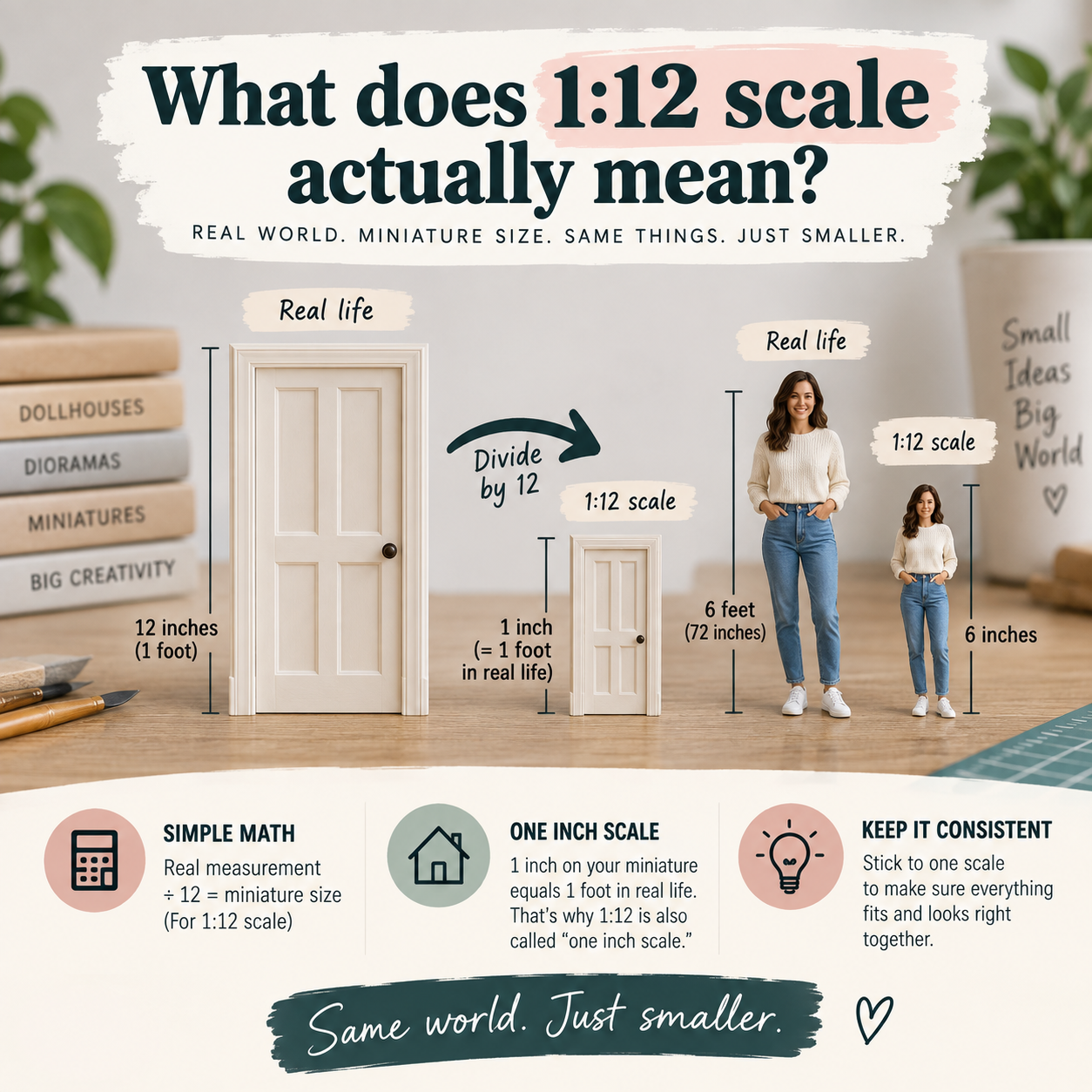
A scale ratio tells you how much smaller your miniature is compared to the real object. 1:12 means one unit of measurement on your miniature equals 12 of that same unit in real life. So a 12-inch-tall real door becomes a 1-inch-tall miniature door. A 6-foot-tall person becomes a 6-inch-tall miniature person. The math is always the same: take the real measurement and divide by 12.
That’s why 1:12 scale is sometimes called “one inch scale” in dollhouse circles. One inch on the model equals one foot in real life, which happens to make the math dead simple for anyone working in imperial units. A standard 8-foot ceiling becomes an 8-inch ceiling. A 3-foot-wide doorway becomes a 3-inch-wide doorway. You don’t need a calculator, just divide by 12 or, if you’re already thinking in feet, don’t divide at all.
Why there are so many different scales
1:12 is the most common scale in dollhouse building, especially for traditional Western-style dollhouses, but it’s not the only one you’ll run into. 1:24 (half-inch scale) cuts everything in half again, so that same 12-inch door becomes half an inch tall. It’s popular for people who want a full dollhouse without needing a full room to display it in. 1:48 (quarter-inch scale) is smaller still and shows up more in model railroading crossover projects than in traditional dollhouse work.
Then there’s the smaller crowd, 1:6 scale, which is what most fashion dolls and some anime figures use. A 1:6 miniature is actually pretty large compared to 1:12 or 1:24, which trips people up constantly when they buy furniture kits without checking the scale first and end up with a chair that’s either doll-sized or dollhouse-sized depending on which “miniature” they thought they were buying.
The mistake almost everyone makes early on
The most common beginner mistake isn’t picking the wrong scale, it’s mixing scales without realizing it. You buy a beautiful 1:12 miniature teapot from one shop and a 1:24 dining table from another, and suddenly your teapot looks like it belongs to a giant. Scale consistency matters more than any single piece looking good on its own. Before buying or building anything, decide on one scale for the whole project and stick to it, even if that means passing on a piece you love because it’s the wrong ratio.
If you’re building your own furniture instead of buying kits, the conversion math becomes your best friend. Say you’re making a 1:12 scale bookshelf and you want it to look like a real 6-foot-tall bookshelf. Divide 72 inches (6 feet) by 12 and you get 6 inches. That’s your target height. Want the same bookshelf in 1:24 scale instead? Divide by 24 this time, and you land at 3 inches.
A quick way to check your math
A trick a lot of experienced miniaturists use: keep a small reference object at your actual scale nearby while you work. If you’re building in 1:12, a standard playing card is close to the width of a real door at that scale, and a AA battery is roughly the height of a soda can. Having a physical reference stops you from eyeballing a piece and getting the proportions subtly wrong, which happens more than you’d think even to people who’ve been doing this for years.
Picking a scale if you’re just starting out
If you don’t have a strong reason to go smaller, 1:12 is the easiest entry point. It’s the most widely supported scale for prebuilt furniture, kits, and printable templates, which means less converting and more building. Save 1:24 or smaller for when you’ve got a specific reason, limited display space, a themed collection, a particular kit you fell in love with, rather than starting there by default.
FAQ
What’s the difference between 1:12 and 1:6 scale? 1:12 scale means the miniature is one-twelfth the size of the real object, so it’s the smaller of the two. 1:6 scale is one-sixth the size, meaning it’s roughly twice as large as a 1:12 piece of the same real-world item. Fashion dolls and many action figures use 1:6, while traditional dollhouses use 1:12.
Can I mix furniture from different scales in one dollhouse? Technically you can, but it usually looks off. A 1:24 chair next to a 1:12 table will look tiny and mismatched. If you want variety without a scale clash, look for kits and pieces specifically labeled for your chosen scale before buying.
How do I convert centimeters instead of inches for 1:12 scale? Same idea, different unit. Take the real-world measurement in centimeters and divide by 12. A 240 cm wide real doorway becomes a 20 cm wide miniature doorway.
Is there a scale smaller than 1:48 used in miniatures? Yes, though it’s less common outside of specific hobbies like model railroading, where scales like 1:87 (HO scale) and 1:160 (N scale) are standard. Most dollhouse and diorama crafters stick to 1:12 through 1:48.
Why do some sellers list “1 inch scale” instead of 1:12? They mean the same thing. “1 inch scale” is just the common nickname for 1:12 scale, since one inch on the miniature equals one foot in real life.